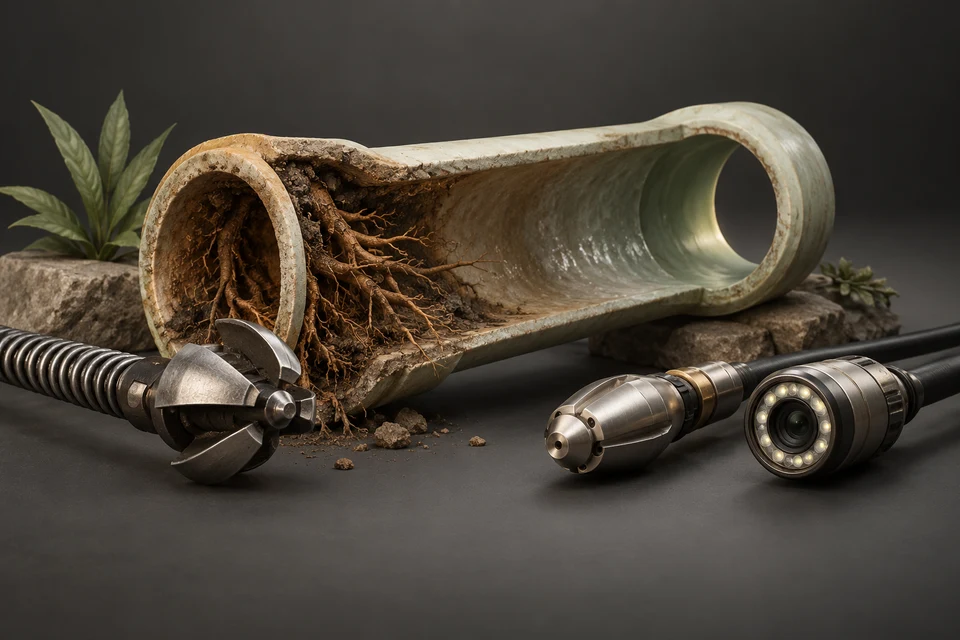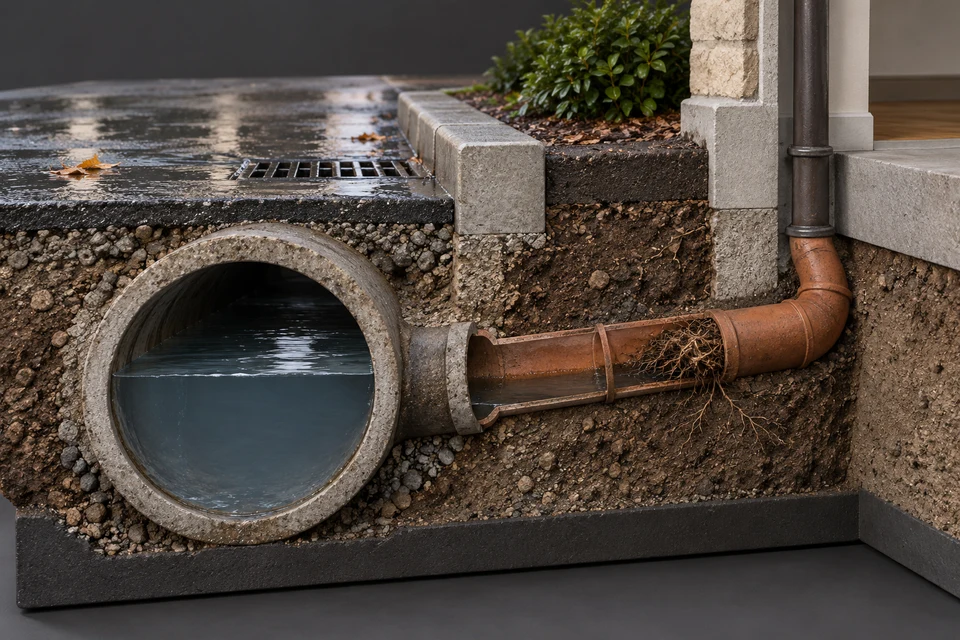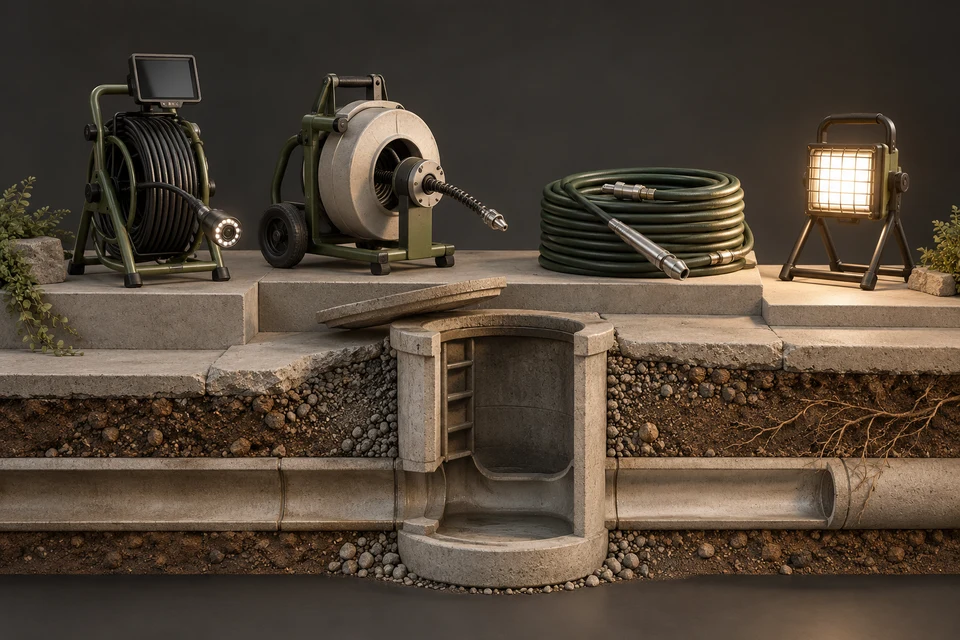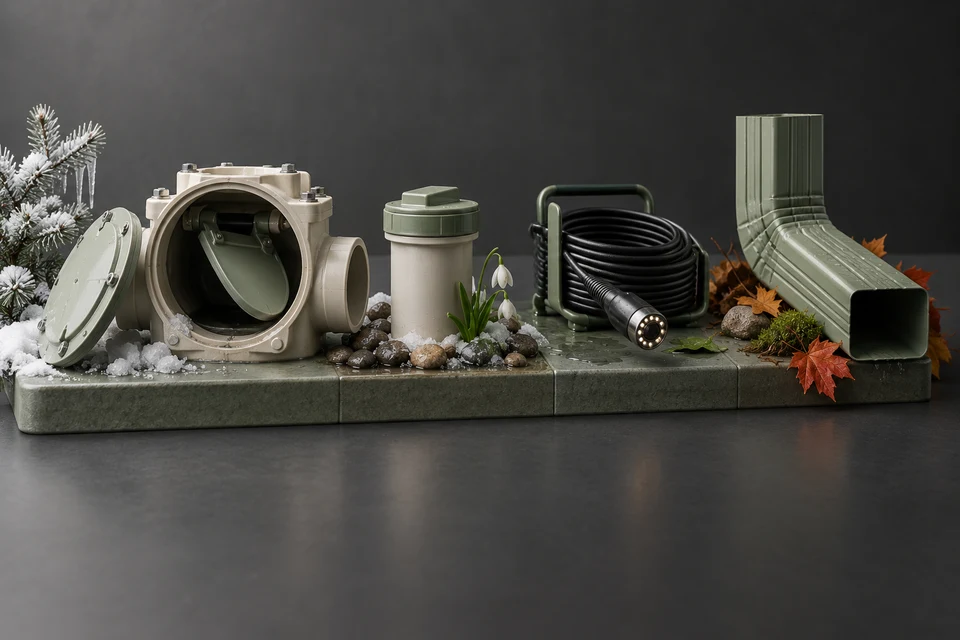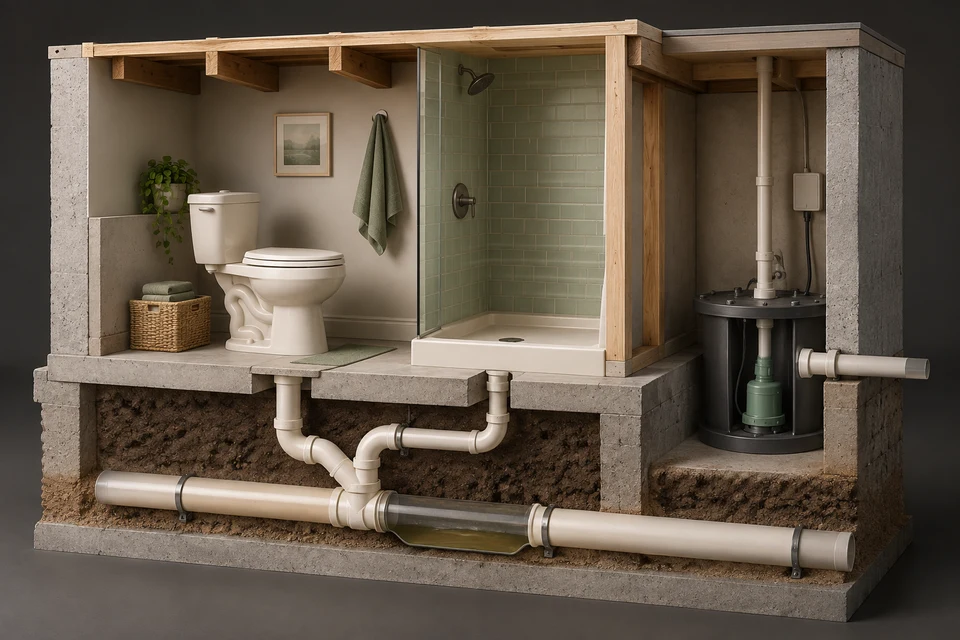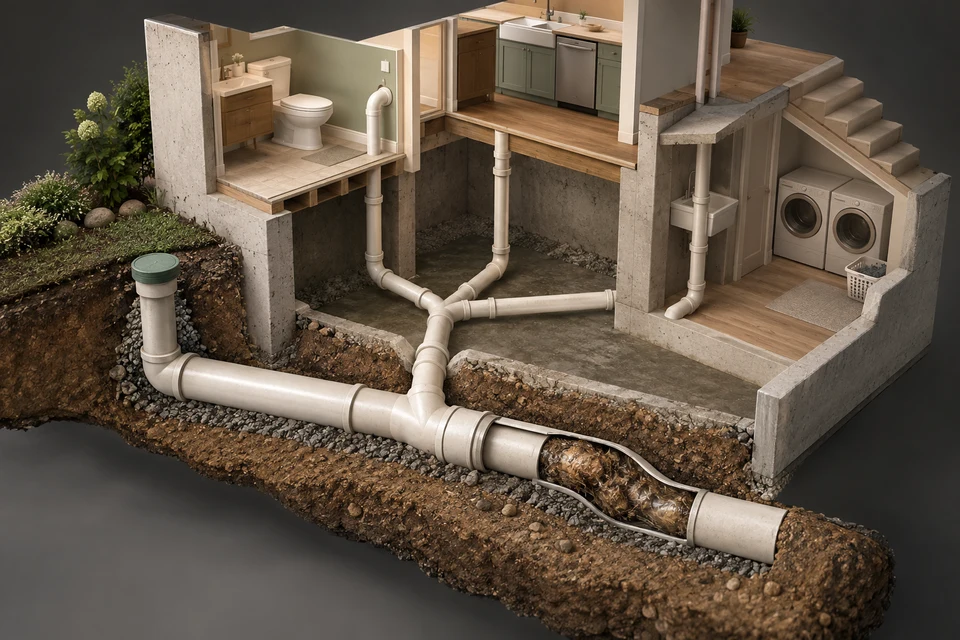
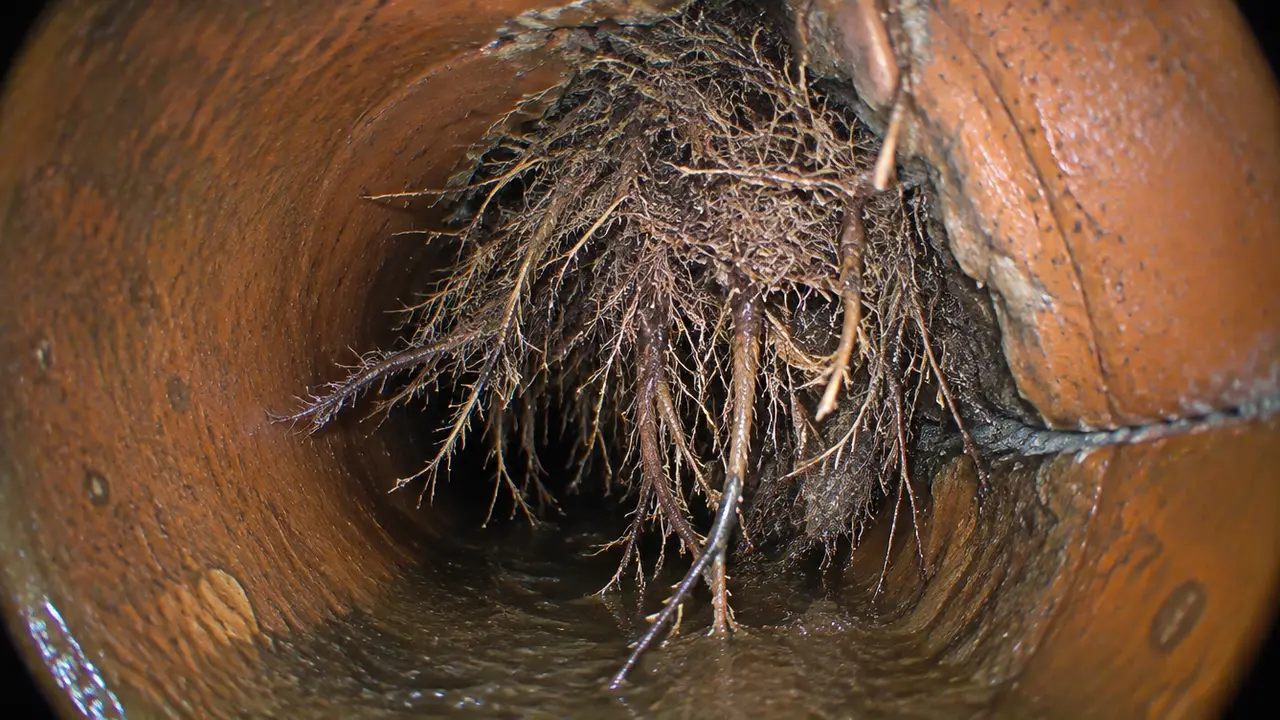
A main line clog shows up as several fixtures misbehaving together, usually water at the basement floor drain when a toilet flushes or the washer drains. In Calgary houses it most often forms where roots enter clay tile joints under the front yard, at the base of old cast iron stacks, in sags, or at a backwater valve. Clear it from the cleanout, then camera it to learn which.
- Two fixtures at once is the test: if the floor drain answers, the clog is past the point where their drains join.
- House era predicts where the clog is likely to be; the camera confirms it.
- Book with specifics: cleanout location, backwater valve, what happened, community and house age.
- Repeat clogs have a cause with a cycle: roots in summer, grease around holidays, wipes any time, sags always.
- A clog that returns within months of a proper clearing is a repair conversation, not a cleaning schedule.
01 /How do you know it is the main line and not one drain?
It is the main line when fixtures that share nothing but the building drain start misbehaving together. A kitchen sink clog stays in the kitchen. A main line clog makes the basement floor drain gurgle when a toilet flushes, pushes water up the floor drain when the washer pumps out, and slows every fixture on the lowest level at once.
- Run the kitchen tap and flush an upstairs toilet at the same time.
- Watch the basement floor drain and the basement toilet or shower.
- If water rises at the floor drain, bubbles up the shower, or the basement toilet bowl level moves, the restriction is downstream of where those drains join: the building drain or service line.
- Stop the test as soon as water appears. You have your answer; basement toilet and shower backups reads the other basement patterns.
If water appears at the floor drain with nothing running at all, the problem may be outside your line. Read storm surcharge or private blockage before calling a contractor.
02 /Where do main line clogs form in Calgary houses?
They form where the pipe changes: at joints, at changes of material, at bends, at low spots and at fittings. Calgary's housing eras put those weak points in predictable places. Treat the table as a starting hypothesis to test with the camera, not a diagnosis.
| Era of house | Likely building drain and service line | Where clogs usually start |
|---|---|---|
| 1940s–1950s inner city and early suburbs | Cast iron inside; clay tile or cast iron outside, sometimes replaced | Scale at the stack base; roots at clay joints; the cast iron to clay transition |
| 1960s–1970s suburbs | Cast iron or early plastic inside; clay tile service line common | Roots at clay joints under the front yard and near the property line |
| 1980s–1990s | ABS inside; PVC service line | Grease and wipes; bellies from settled backfill; construction debris in rare cases |
| 2000s and newer | ABS and PVC; backwater valve often fitted | Debris on the backwater valve flap; wipes; grease |
| Infill on an older lot | New pipe on the private side; City side may be older | The connection point; any retained old section |
The City's service line data backs up the era pattern for the City-owned portion. Citywide, clay tile (the City's TIL code) accounts for about one in five City-side lines, most of them laid in the 1960s and 1970s, before PVC became standard in the 1980s. Your private portion may differ, but a TIL record on your street is a good reason to expect joints on your side too.
03 /Where is your access, and why does it matter?
The main cleanout is the right door into a main line clog. It sits on the building drain, usually in the basement near the front wall, and gives a cable or jetter the straightest route to the City main. Without it, a technician has to pull a toilet or go in through a roof vent, which costs more and reaches the problem less directly.
- Find it before you need it; the City also asks for about two metres of clear space around it if a crew is coming.
- If it is under flooring or behind a wall panel, make it removable rather than permanent.
- If your house has a backwater valve, know where the access cover is. Cleaning should go through that access as designed, not through the flap.
- If there is no usable cleanout at all, ask for a price to add one after the clog is cleared. It pays back on the next call.
04 /Can you clear a main line clog yourself?
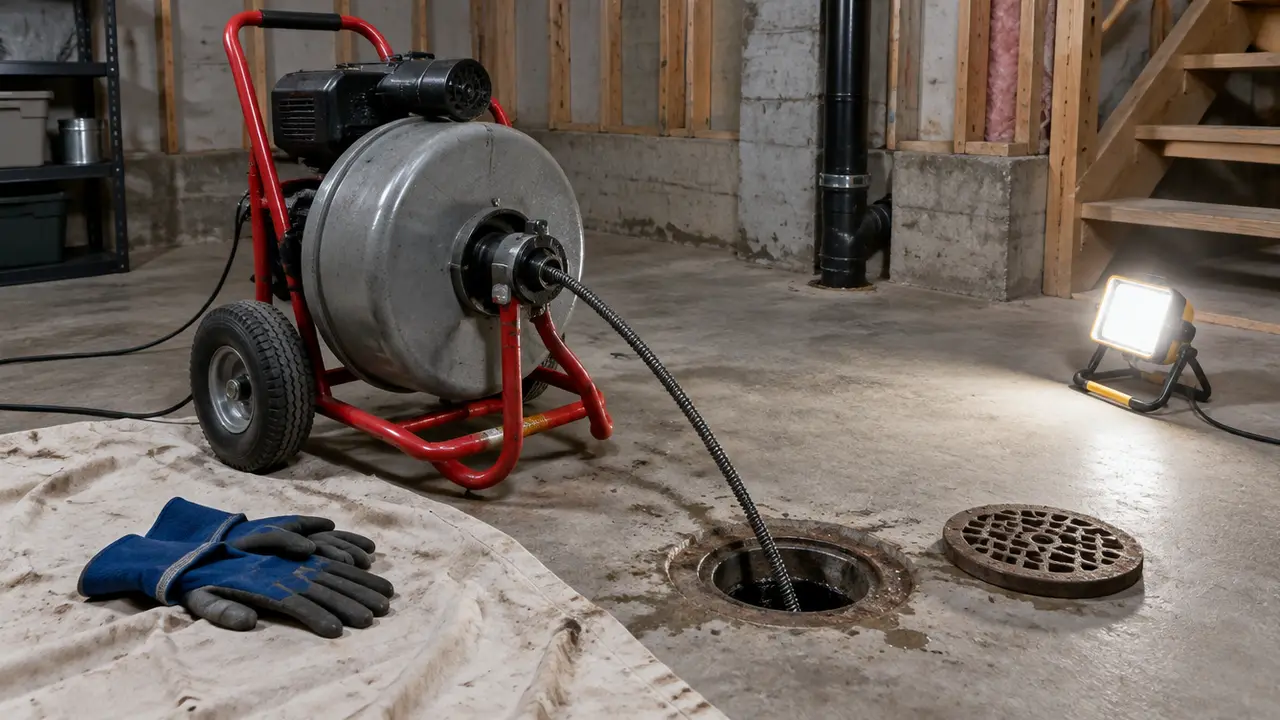
Some homeowners can, with a rented sectional or drum machine, the right head and real caution, but it is the point where do-it-yourself drain work becomes genuinely hazardous. A rotating cable that catches can whip or wrap around a hand; a line full of sewage releases its contents when the cleanout is opened; and sewer gas in a closed basement is not something to breathe for long.
If you do clear it yourself, you have still only done half the job. You do not know why it clogged. Book a camera inspection before you decide whether it was a one-off.
05 /What should you tell the contractor when you book?
Tell them enough to send the right technician with the right machine. A precise booking also makes phone quotes more meaningful.
- Which fixtures are affected and what happens when water runs.
- Whether water rises with all water off.
- Where the cleanout is and whether it is accessible.
- Whether there is a backwater valve.
- Your community and the approximate age of the house.
- Any history: previous clearings, the distance where roots were found, earlier camera reports.
- That you want the camera run to the main, with the video and distances.
In Calgary, confirm the company holds a City of Calgary business licence and can hand you a current WCB-Alberta clearance and an insurance certificate. The rest of the vetting checklist is in how to vet a Calgary drain contractor.
06 /Why did the clog come back?
Because the cause is still there. Clearing restores flow; it does not change the pipe. The timing of repeat clogs usually points to the cause.
| Pattern | Likely cause | What changes it |
|---|---|---|
| Every summer, worse each year | Roots re-entering clay or concrete joints | Scheduled root cutting, then lining or joint repair |
| After holidays and big family meals | Grease from the kitchen branch settling in the main | Grease habits, jetting, checking for a sag |
| Irregular, with wipes or paper in the debris | Wipes or heavy paper use snagging on a joint or root hair | A bathroom bin and a camera check of the snag point |
| Every few months regardless of season | A sag or offset holding solids | Spot repair or replacement of the section |
| After heavy rain only | Surcharge or inflow, not a private clog | Backwater valve, 311 report |
If a line has needed clearing twice in a year after proper cleaning, compare the running cost of maintenance with the cost of fixing the defect. The service call cost page shows both sides as planning ranges, and CalgarySewerReplacement.ca walks through what a Calgary repair involves.
07 /How do you keep it from happening again?
Match prevention to the cause the camera found, then put it on a calendar. For roots, time a cut before the summer growth peak and plan the permanent fix. For grease, change kitchen habits and consider jetting instead of repeated cabling. For a sag, stop treating it as a cleaning problem. The Calgary sewer season calendar lays the tasks out month by month for your house era, and if you want a contractor to look, request a quote.
FAQQuestions people ask
What does a main line clog sound like?
Gurgling from the basement floor drain or a basement toilet when an upstairs fixture drains, and bubbling in the toilet bowl when the washing machine pumps out. The sound is air being pushed ahead of water that cannot get past the restriction.
Can a main line clog fix itself?
A soft clog of paper can sometimes wash through, but roots, grease, wipes and sags do not go away. If the symptoms ease on their own, book a camera inspection anyway so you know what is there.
Is a floor drain backing up always a main line clog?
No. It can be a clog in the floor drain's own trap, a surcharge from the City main, or the washing machine overwhelming a partly restricted line. The two-fixture test and the water-off test separate them.
How long does main line cleaning take?
A straightforward clearing from an accessible cleanout often takes about an hour, plus camera time. Roots, long lines, a missing cleanout or a backwater valve can stretch that.
Should I camera my line after clearing it?
Yes, especially in a house built before the 1980s. Clearing restores flow; only the camera shows whether you have roots, a sag, an offset or broken pipe, and where it is relative to your property line.
NETWORKGo deeper across the HAUSE Sewer network
Clog Locator: find the blockage before you pick up a cable
Use the Clog Locator to find where a drain clog sits (trap, branch, stack, main or lateral) and which auger class and cable size fits the pipe.
SewerInspector.caInspecting the sewer after a backup: finding out why it happened
Why a sewer camera inspection after a backup matters: private vs municipal causes, timing, what to record for insurance, and how to stop it happening again.
SewerCleaners.caSewer Maintenance Planner
Sewer Maintenance Planner: a suggested cleaning and camera inspection interval plus a 12-month checklist based on your house, pipes, trees and history.