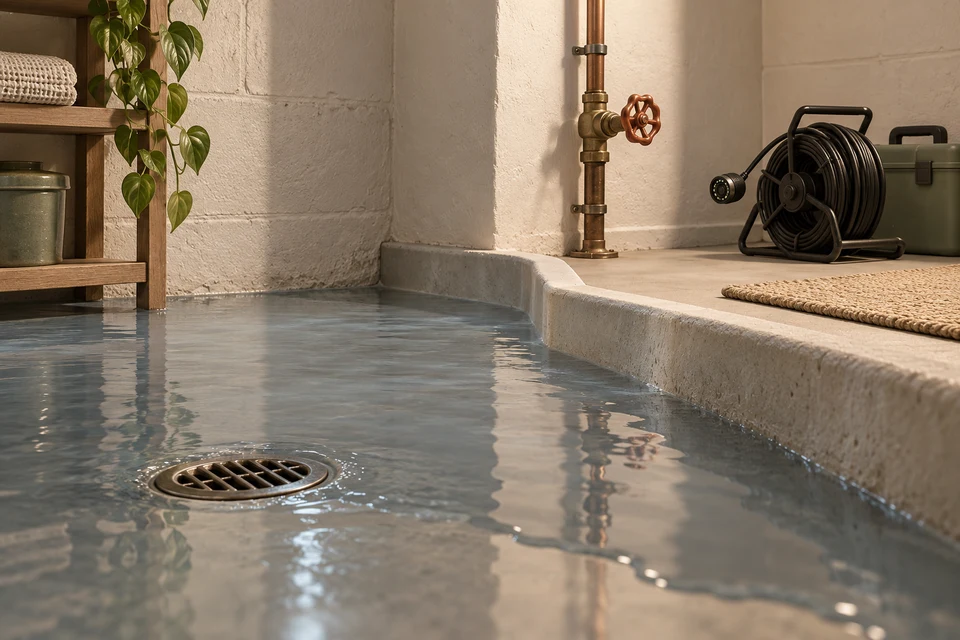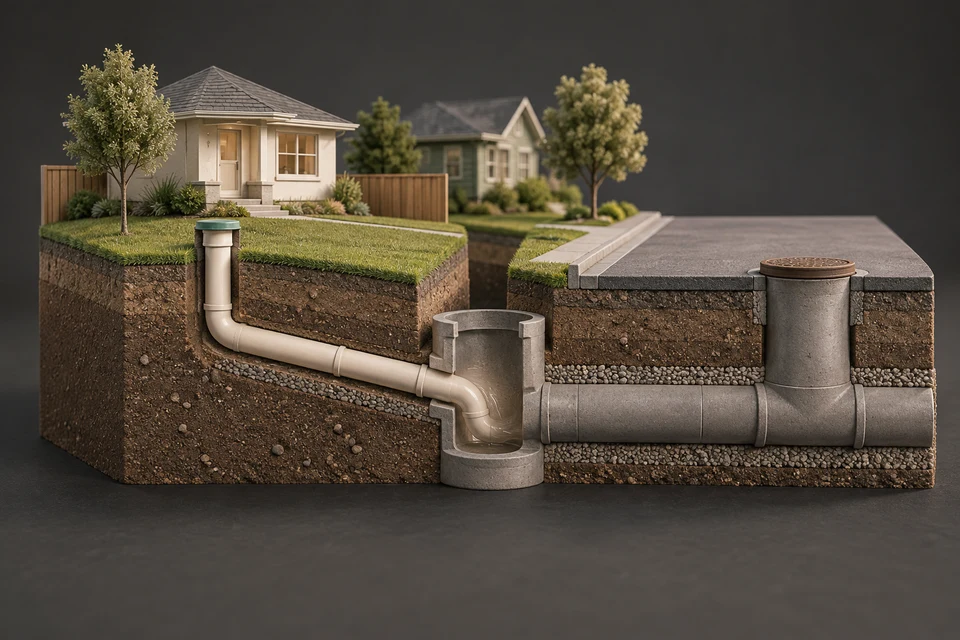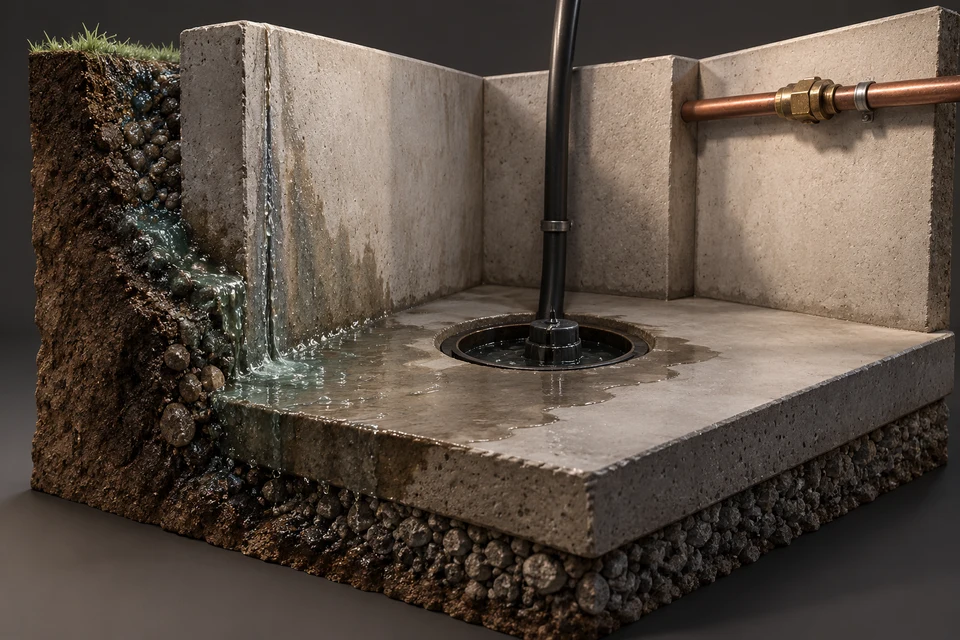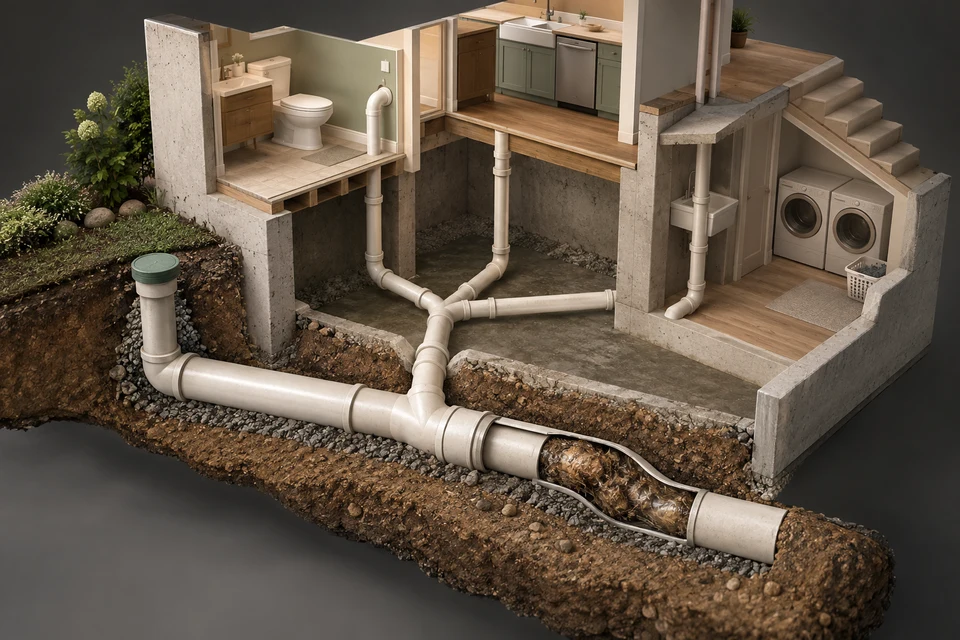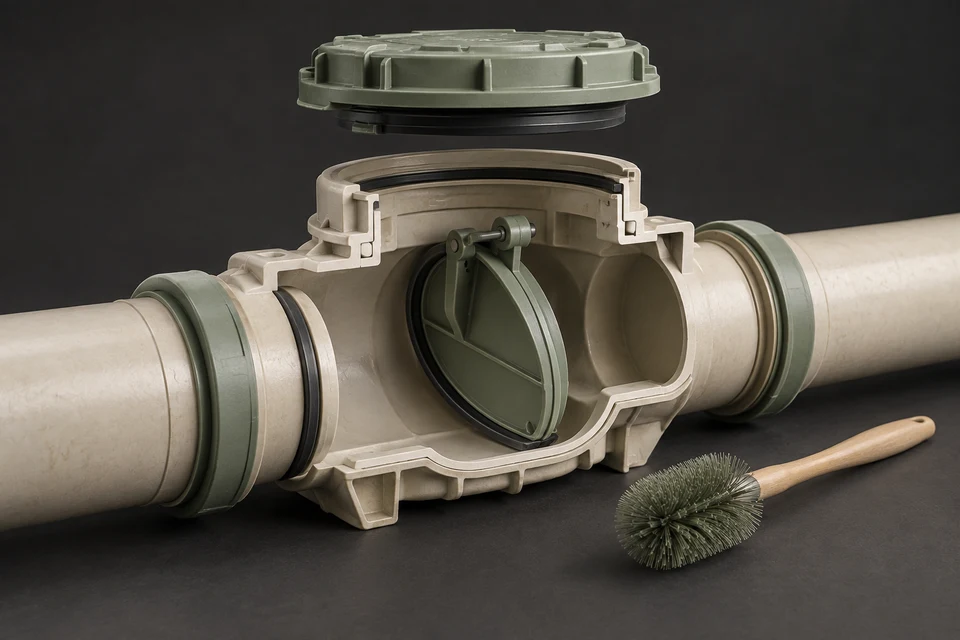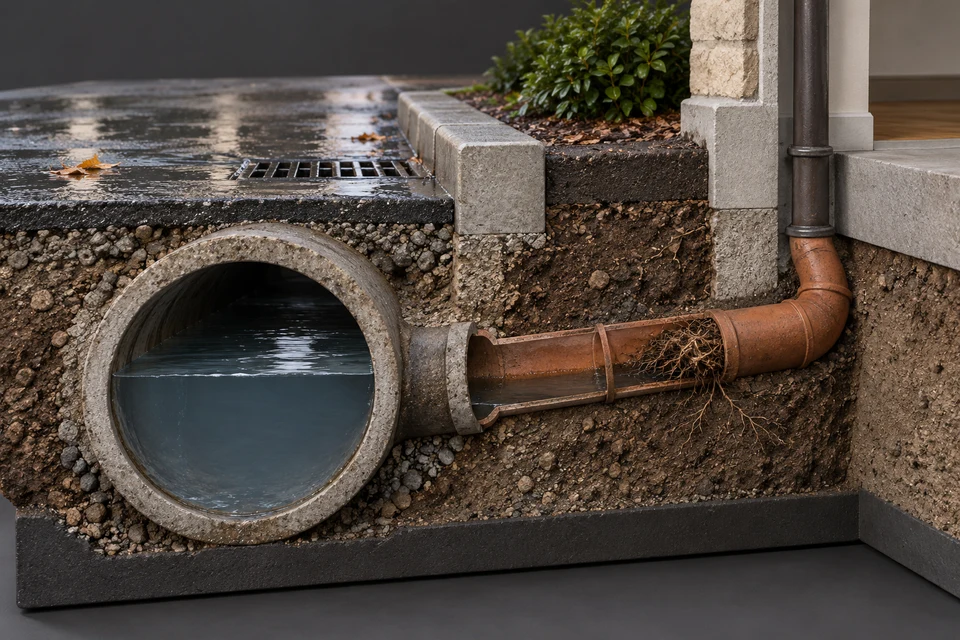
A private blockage backs up only when your household uses water and usually affects your home alone. A surcharge happens when the sewer main is full, often during heavy rain or fast melt, so sewage can rise in your floor drain with every tap off and neighbours are often affected. Run a water-off test, check with two or three neighbours, and call 311 if the main is suspected.
- The single best test: stop all water use for 30 minutes. Water that keeps rising points away from your own line.
- Heavy rain plus neighbours with the same problem is the classic surcharge pattern; report it to 311.
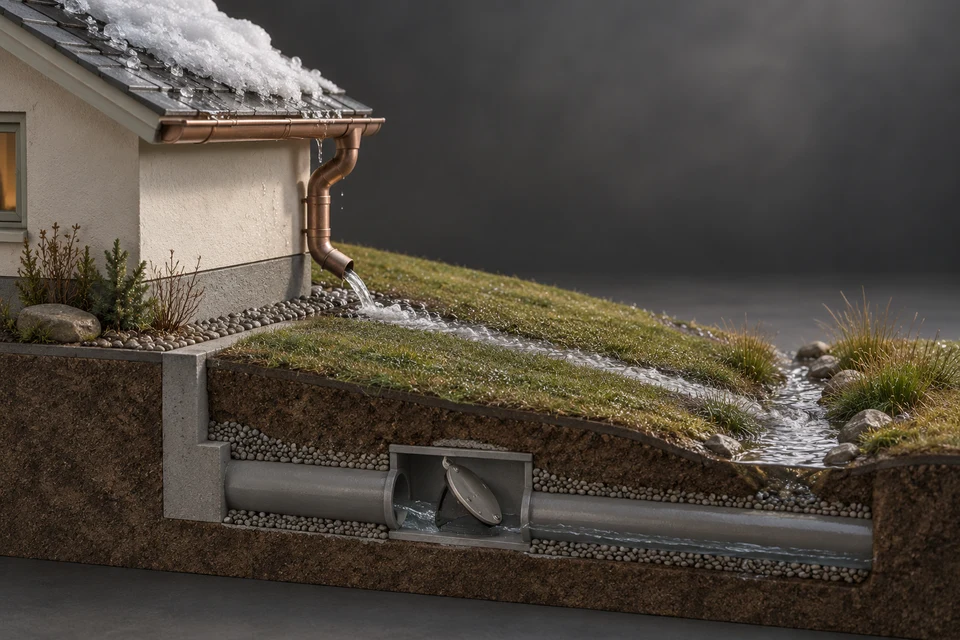
- Calgary's sanitary and storm systems are separate, but rainwater still reaches sanitary pipes through cracks, open joints and wrong connections.
- A closed backwater valve protects you from a surcharge but turns your own drains into a dead end, so stop water use while it is closed.
- The camera, not the symptom, has the last word on where a private blockage sits.
01 /What is the difference between a surcharge and a private blockage?
A private blockage is a restriction in your own building drain or service line, so your household's wastewater cannot get out. A surcharge is the opposite problem: the City's sanitary main is running full or is blocked downstream, so there is no room for your wastewater to enter it, and sewage in the main can push back up your service line toward the lowest opening in your house.
Both end the same way, with water at the basement floor drain, but they call for different people. A private blockage is the owner's to clear. A surcharged or blocked main is a City matter. The City of Calgary's published split puts the pipe from the main to the property line in City ownership and the pipe from the property line to the house in the homeowner's.
Calgary runs a sanitary system for household wastewater and a separate stormwater system of storm drains, pipes and ponds for runoff. In theory rain never reaches the sanitary pipes. In practice some does, through cracked service lines, open joints, manhole covers in low spots and older foundation drain or downspout connections that should not be there. When a big storm pushes enough of that extra water into the sanitary system, parts of it can run full.
02 /Which clues point to your own line, and which to the main?
No single clue is proof, but together they usually point one way. Read across the table and count which column wins.
| Clue | Points to a private blockage | Points to a surcharge or City-side problem |
|---|---|---|
| Weather | Dry weather, no recent melt | During or shortly after heavy rain or a fast chinook melt |
| Neighbours | Nobody else on the street affected | Two or more homes on the same run affected |
| Water use | Rises only when someone runs water | Rises with all water off |
| History | Slow drains and gurgling for weeks before | No warning; drains were fine yesterday |
| Timing | After laundry, a bath or a houseful of guests | Evening peak or storm peak, regardless of what you do |
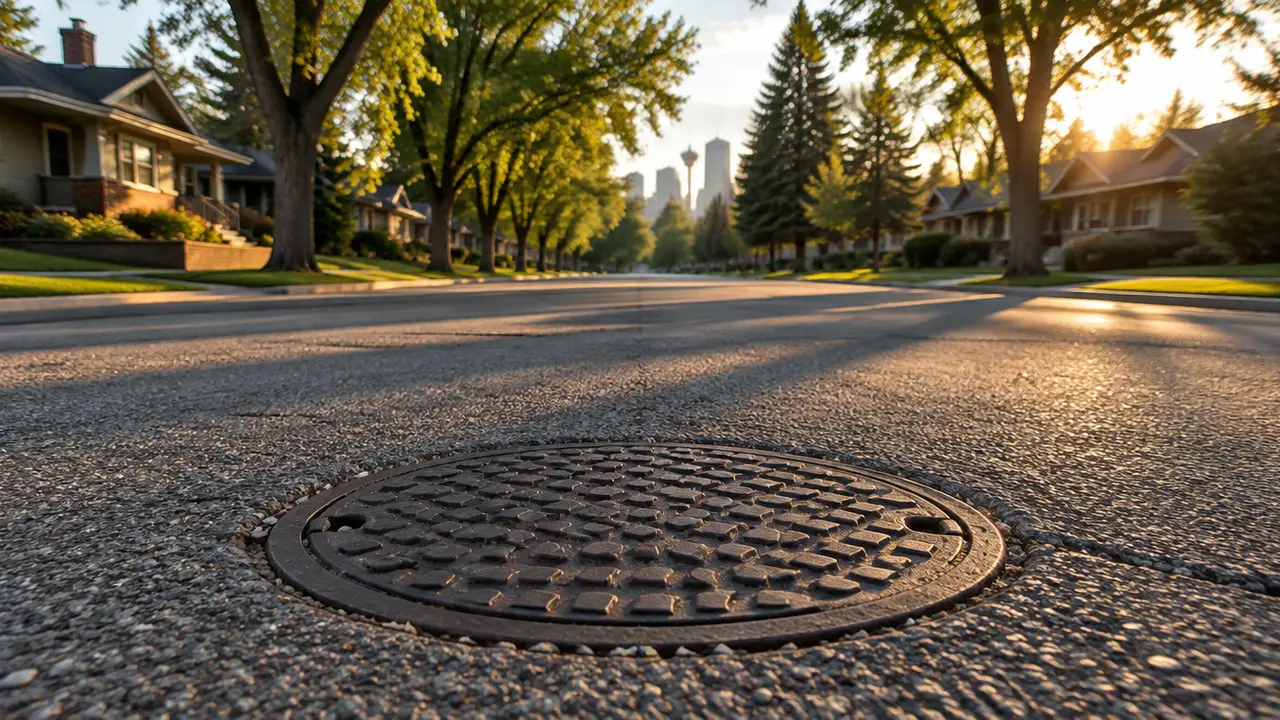
| Street | Nothing unusual outside | Water or sewage around a manhole, crews already on the street |
| Recurrence | Same fixture group every few months | Only in the biggest storms |
A mixed result is common. A partly root-blocked lateral may cope in dry weather and fail in a storm, because slightly higher water in the main is enough to tip it over. That is why the next step is a test, not a guess.
03 /How do you run a water-off test safely?
Stop every source of water use in the building for 30 minutes and watch the lowest drain from a dry spot. If the water level holds or slowly falls, the problem is most likely a restriction in your own line that only shows when you add water. If it keeps rising, or sewage appears at a drain while nothing in the house is running, water is arriving from outside your plumbing.
- Tell everyone in the building
Upstairs occupants, suite tenants and anyone about to start a load of laundry. A dishwasher or washing machine mid-cycle will spoil the test; stop the cycle if it is safe.
- Mark the water line
Put a piece of tape or a pencil mark at the current edge of the water, or note which tile it has reached. Do not stand in it.
- Wait and watch for 30 minutes
Check every ten minutes. Note whether the level moves, whether anything bubbles up, and whether it smells stronger.
- Check the street
From the sidewalk, look at nearby manholes and storm drains, and ask a neighbour or two whether their floor drains are behaving.
- Call the right party
Rising with water off: call 311 and say so. Steady or falling: a private blockage is likely; 311 may still triage it, but expect to need a drain contractor.
04 /What does a backwater valve change in a surcharge?
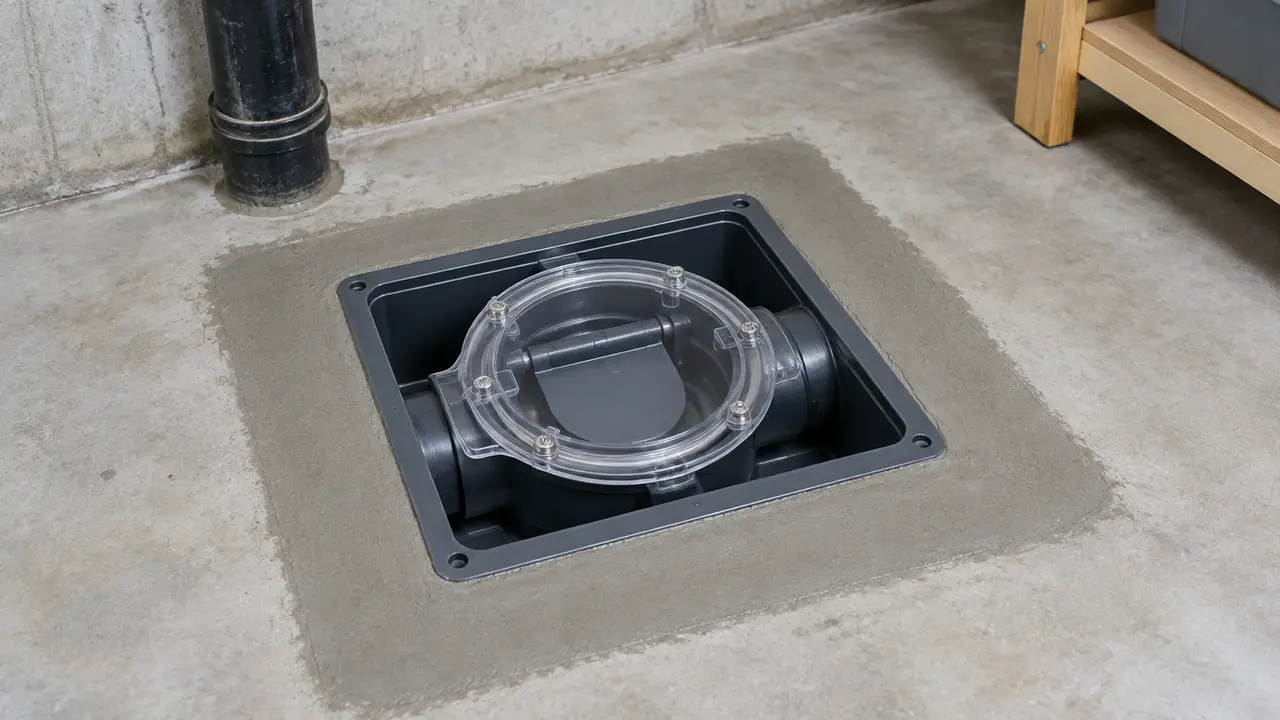
A backwater valve shuts when sewage starts moving the wrong way from the main, keeping a surcharge out of your basement. The catch: once shut, it also traps your own wastewater inside. Water you use upstairs collects behind the flap and can come out of the basement floor drain on the house side of the valve. So in a storm, the rule for a house with a closed valve is the same as for a blocked line: stop using water.
According to the City of Calgary, installing a backflow prevention device takes a plumbing permit; the City recommends a qualified plumber and says the valve should be graded down toward the municipal sewer at a minimum two percent slope. For homes in flood-prone areas near the Bow River, Elbow River, Nose Creek or West Nose Creek, the City points residents to its Land Use Bylaw to check whether one is required. If you already have a valve, the City's advice is to keep it properly serviced and maintained.
Two signs mean the valve is involved in your backup. Water appearing only in the valve box, or at a drain upstream of it, during a storm usually means the valve closed and you kept using water. Water coming up during a storm in a house with a valve suggests the flap is stuck open, fouled with debris, or missing its cover seal. Backwater valve maintenance in Calgary matches these symptoms to their usual causes.
05 /Why do the neighbours matter so much?
Your neighbours on the same run of main are the cheapest diagnostic tool you have. If three houses in a row have water at the floor drain during the same storm, their private lines did not all block at the same minute. If only your house has a problem, the main is less likely to be the cause.
- Ask the houses on either side and one or two across or down the street, not just your friends on the next block; they may be on a different main.
- Ask whether they have a backwater valve. A neighbour with a valve may see nothing even when the main is full.
- Ask about timing. Backups that started within the same hour are a strong pattern.
- Tell 311 the addresses affected. Several reports from one street help the City locate the problem.
In some older Calgary areas, services may connect to mains in the lane rather than the street. If you are unsure which way your line runs, the location of your cleanout and the direction of the pipe leaving the house are good hints, and 311 can confirm.
06 /What should you tell 311 in each case?
Give 311 facts, not conclusions. The agent is deciding whether to send a crew, and specific answers make that decision better.
When a City crew comes, its first job is to push a steel snake from your cleanout toward the main and learn which side of the line the blockage sits on. Be ready with a clear two-metre working space around the cleanout, as described in what to do in a Calgary sewer backup.
07 /What can the City's service line records tell you?
The City publishes the material and installed date of the public portion of each sanitary service line, which is the stretch the City owns between its main and your property line. It cannot tell you about your private section, which can be a different material and age. Still, it gives useful context. In an analysis of that dataset, about one in five City-side service lines citywide are coded TIL, the City's tile code, generally read as clay tile, and in communities the City classifies as 1960s/1970s the TIL share is 77.5 percent.
Clay tile joints are where roots and groundwater get in, which matters for both halves of this question: a root-restricted joint can cause a private blockage, and leaky joints across a whole neighbourhood add storm water to the main. For the numbers by community and a lookup of your own address, see CalgarySewers.ca. To reason through your specific situation, try the City or Owner triage tool, and if it points to your side, the Calgary main line clog guide is the next stop.
FAQQuestions people ask
Can a sewer backup happen when it is not raining?
Yes. Most dry-weather backups are private blockages from roots, grease, wipes or a sag. A blocked main can also cause a dry-weather backup, which is why the water-off test and a word with the neighbours come before any conclusion.
Why did my floor drain back up during a storm if Calgary has separate storm sewers?
Rainwater still reaches sanitary pipes through cracks, open joints, low manhole covers and illegal or historic connections of downspouts and foundation drains. In a big storm that extra water can fill parts of the sanitary system and push back up service lines.
My neighbour has no problem but I do. Can it still be the main?
It can, if your house is lower, has no backwater valve while theirs does, or connects to a different section of main. It is less likely, though. Run the water-off test and tell 311 exactly what you saw.
Should I close my backwater valve manually before a storm?
Most residential valves close automatically; some models have a manual closure feature. If yours does, follow the manufacturer's instructions, and remember that a closed valve means no drains are usable until you reopen it.
Does a surcharge damage my sewer line?
A surcharge itself rarely damages a sound line, but repeated backflow can move debris into your service and deposit it at sags or joints. A camera inspection after a major event is reasonable, especially on an older line.
NETWORKGo deeper across the HAUSE Sewer network
What causes sewer backup, and how to tell which cause is yours
What causes sewer backup: roots, grease, wipes, sags, broken pipe, frozen lines and rain-overloaded city sewers, plus how to tell which one caused yours.
SewerInspector.caInspecting the sewer after a backup: finding out why it happened
Why a sewer camera inspection after a backup matters: private vs municipal causes, timing, what to record for insurance, and how to stop it happening again.
SewerRoots.caRoots in the main sewer line: is it your lateral or the city's sewer main?
Roots in the main sewer line: how to tell your own lateral from the city sewer main, clues that point to the public side, and who to call first.