City or Owner? asks where the problem shows, whether neighbours are affected, whether it is during heavy rain, and what a camera found. It then applies five rules to suggest a first call: 311 because the City is likely involved, 311 for a possible main surcharge, a shared case for 311 with footage, a likely owner case for a drain contractor, or start with the owner side.
- Four inputs: where the problem shows, neighbours, heavy rain, and the camera result.
- Street, manhole or boulevard symptoms, or a camera finding in the City main, point to 311 first.
- Neighbours affected during heavy rain suggests a surcharged main; check your backwater valve and call 311.
- A defect at or past the property line is a shared case: call 311 with the footage and the footage-counter distances.
- Every result repeats the City's published ownership split and that the City makes the final determination.
City or Owner? Responsibility Triage
01 /What does the City or Owner tool do?
It turns four facts you can observe into a first call: 311, a drain contractor, or both in a particular order. Calgary homeowners lose hours and sometimes money by calling the wrong party first, paying a contractor to chase a surcharged City main, or waiting on the City for a blockage in their own front yard. The tool makes the usual reasoning explicit so you can see which way your situation leans before you pick up the phone.
It is a triage aid, not a ruling. The City of Calgary decides responsibility for any specific case. What the tool does is sort your situation into the pattern it most resembles and tell you what to do next, with the reasons.
- Answer four questions
Where the problem shows, whether neighbours are affected, whether it is happening during heavy rain, and what a camera inspection found, if you have had one.
- Read the verdict and reason
The tool shows one headline result and why your answers led there.
- Act on the next step
Call 311, call a drain contractor, or do one and then the other, as the result suggests.
- Keep the ownership note
Every result shows the City's published ownership split and that the City makes the final determination.
02 /What inputs does the tool ask for?
| Input | Options | Why it matters |
|---|---|---|
| Where the problem shows | Fixtures in one area; basement floor drain; whole house; water or sewage in the street or a manhole; sinkhole or wet spot in the yard; sinkhole or wet spot in the boulevard or road | Inside symptoms start on the private side; street, manhole and boulevard symptoms are on public land |
| Neighbours affected | Yes; no; unknown | A shared main affects several homes at once; a private line affects one |
| During heavy rain | Yes; no | Storms can push extra water into the sanitary system and surcharge mains |
| Camera result | Not inspected; defect on the private side; defect at or past the property line; blockage in the City main | The camera is the strongest evidence of where a problem actually is |
Answer as precisely as you honestly can. Choose unknown for neighbours if you have not asked; the tool treats unknown differently from no. If you have camera footage, use the result the technician gave you, including the footage-counter distance if they told you where the property line falls.
03 /What rules does the tool apply?
The tool checks five rules in priority order, and the first rule that fits your answers sets the result. Public-side evidence comes first, then the storm pattern, then camera evidence, then the inside-only pattern, then the default for inside symptoms without a camera.
| # | If your answers include | Result | What to do |
|---|---|---|---|
| 1 | Water or sewage in the street or a manhole; or a sinkhole or wet spot in the boulevard or road; or a camera result of a blockage in the City main | Call 311 first — likely City | Report it through 311 with what you saw and where |
| 2 | Neighbours affected: yes, and during heavy rain: yes | Call 311 — possible main surcharge | Call 311 and check your backwater valve |
| 3 | Camera result: defect at or past the property line | Shared — call 311 with the footage | Give 311 the video and the footage-counter distances |
| 4 | Camera result: defect on the private side; or symptoms inside only with neighbours: no | Likely owner | Hire a drain contractor; camera with a locate |
| 5 | Camera: not inspected, with inside symptoms | Start with the owner side | Clear it, then camera; call 311 if the camera shows the problem past your property line |
Inside symptoms are the first three options for where the problem shows: fixtures in one area, the basement floor drain, and the whole house. The street, manhole and boulevard options are public-side symptoms.
04 /How do the rules play out in common Calgary situations?
These worked examples follow the rules above exactly, so you can check your own answers against a similar case.
| Situation | Answers | Result |
|---|---|---|
| Sewage bubbling from a manhole on your street | Street or manhole; any other answers | Call 311 first — likely City (rule 1) |
| Wet, sinking patch in the boulevard strip | Boulevard or road; any other answers | Call 311 first — likely City (rule 1) |
| Floor drain backs up in a storm; two neighbours have it too | Floor drain; neighbours yes; heavy rain yes; not inspected | Call 311 — possible main surcharge (rule 2) |
| Contractor's camera found roots at the property line | Floor drain; neighbours no; rain no; at or past property line | Shared — call 311 with the footage (rule 3) |
| Recurring whole-house backup in dry weather, neighbours fine | Whole house; neighbours no; rain no; not inspected | Likely owner (rule 4) |
| One bathroom slow, you have not asked the neighbours | Fixtures in one area; neighbours unknown; rain no; not inspected | Start with the owner side (rule 5) |
| Camera found a sag two metres from the house | Floor drain; neighbours no; rain no; private side | Likely owner (rule 4) |
Notice what unknown does. In the bathroom example, neighbours unknown keeps the inside-only rule from firing, so the tool falls to the default: clear it, camera it, and call 311 only if the camera shows the problem past your property line. That is deliberately cautious, because unknown could hide a shared problem.
05 /Why is the City's ownership split shown every time?
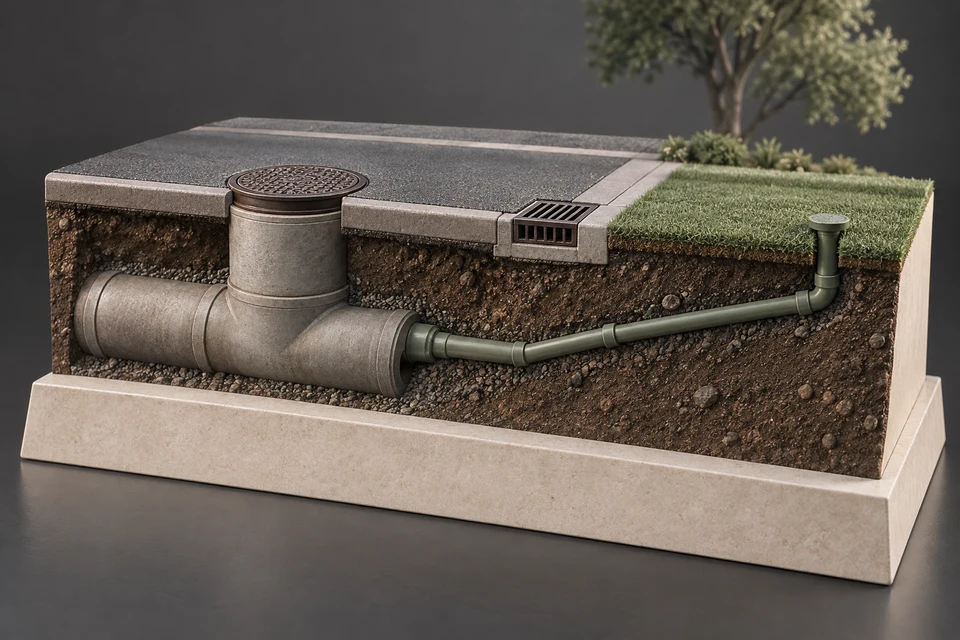
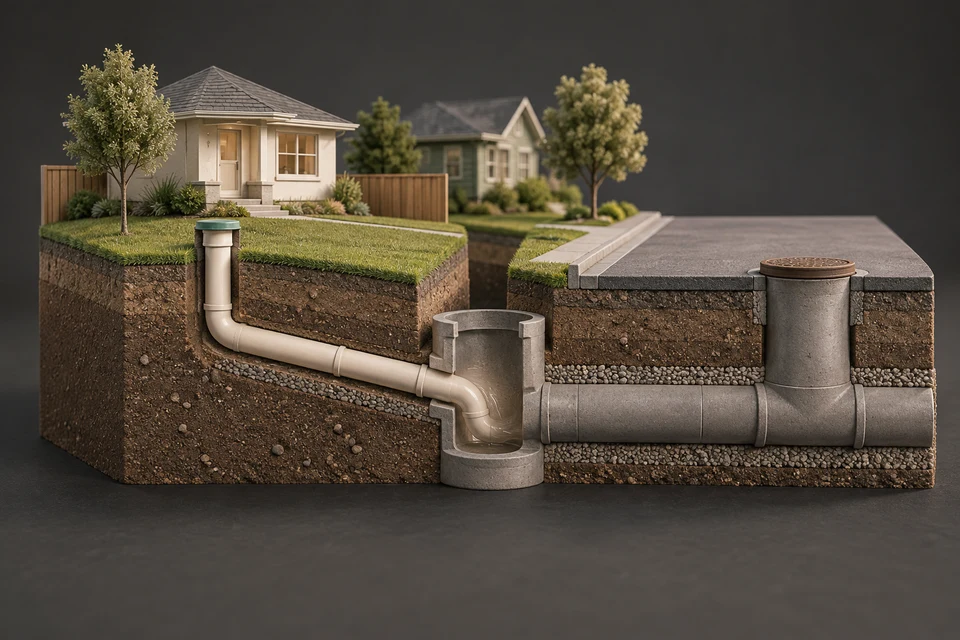
Because it is the fixed point every Calgary sewer conversation starts from, and it comes from the City itself. In the description of its public sanitary service line data, the City says the service pipe can be thought of as two sections: from the sanitary main to the property line, owned and maintained by The City of Calgary; and from the property line to the house, owned and maintained by the homeowner.
The tool repeats that split and adds that the City makes the final determination, because real cases have edges: a defect straddling the property line, a root mass from a boulevard tree growing into the private side, or a record that does not match what is in the ground. Where your case is not clear-cut, 311 decides, and the best thing you can bring is evidence.
06 /What evidence helps 311 decide?
Camera footage with distances is the most useful evidence a homeowner can bring. Ask the contractor for:
- The video file, from the cleanout to the main.
- The footage-counter distance to each defect, measured from the access point along the pipe.
- A locate mark on the ground above the defect, and a note of where that mark sits relative to your property line.
- The access point used, since distances are measured from it.
- What the defect is: roots, crack, offset, sag, break, or a blockage in the main.
Remember that the footage counter measures along the pipe, not in a straight line across the yard. Your property line is on your real property report or title plan, not on the camera. Put the two together, or have the contractor do it, before you conclude which side a defect is on. If the City has already visited, bring its Customer Service Report too; after you call 311 explains what it records.
07 /What are the limits of the tool?
- It does not look up your address or read the City's records. For the City-side material and installed year of your service line, use the lookup at CalgarySewers.ca.
- It does not know where your property line is. Your title plan or real property report does.
- It cannot decide responsibility. The City makes the final determination for any specific case.
- It does not cover large commercial or multi-family services, which the City's service line data also excludes; ask 311 about those.
- It is not an emergency service. If people are in danger, call 911; for a backup in progress, stop water use and follow the steps in what to do in a Calgary sewer backup.
If your answers do not fit any pattern cleanly, for example a wet spot in your own yard with no camera work yet, treat the camera as the next step. For the background on each pattern, read storm surcharge or private blockage and what the City of Calgary does for sewer problems. If the result points to your side, request a quote for clearing and a camera with a locate.
FAQQuestions people ask
Is the City or Owner result official?
No. It is a triage aid based on common patterns. The City of Calgary makes the final determination of responsibility for any specific case, usually after 311 triage and, where needed, a crew visit.
Why does the tool say call 311 when my neighbours are affected in heavy rain?
Several homes backing up during a storm is the typical pattern of a surcharged City main. The City needs to know, and a closed or faulty backwater valve at your house is worth checking at the same time.
What does shared mean in the result?
Your camera found the defect at or past the property line, where City and owner responsibility meet. Call 311 with the video and the footage-counter distances so the City can assess it.
Why does unknown neighbours give a different result from no?
The inside-only rule needs you to confirm that neighbours are not affected. With unknown, the tool falls back to starting on the owner side and calling 311 if the camera shows the problem past your property line.
Does the tool need my address?
No. It asks four multiple-choice questions about symptoms, neighbours, rain and camera results. For the City's record of your service line, use the address lookup on CalgarySewers.ca, and treat the triage result as a note for your 311 call.
NETWORKGo deeper across the HAUSE Sewer network
Whose tree, whose pipe: who pays when roots block a sewer line
Who is responsible when a city or neighbour's tree sends roots into your sewer line: the general Canadian pattern, the evidence, and how to raise it.
SewerInspector.caInspecting the sewer after a backup: finding out why it happened
Why a sewer camera inspection after a backup matters: private vs municipal causes, timing, what to record for insurance, and how to stop it happening again.
SewerQuotes.comSewer permits, inspections and who pays: owner or city?
Sewer line permits and who pays in Canada: the usual owner vs city split, permit and inspection costs, road cuts, city tree roots and what to confirm.